Alcides Fonseca

40.197958, -8.408312

Posts tagged as Society

ChinAI #374: China’s first AI-generated longform TV series

Published in the 16th century, Journey to the West is a classic Chinese novel that tells the tale of Sun Wukong, a mythological monkey that helps a Buddhist monk journey to India. Among the many published sequels to Journey to the West, one of the three main ones, written by an unknown author, is The Later Journey to the West [后西游记]. In this sequel, the story shifts to Sun Xiaosheng, a young stone monkey who grows up on the same mountain long after Sun Wukong departed on his journey.

On August 31, Mango Excellent Media’s TV adaptation of this novel premiered during prime time. “It’s the first-ever fully AI-generated entertainment to hit mainstream provincial satellite prime time,” writes Mandy Wong. After seeing Bytedance Seedance 2.0’s (AI text-to-video model) release earlier this year, the team behind Journey to the West felt there was an opportunity to make a long-form series and break through a market “saturated with uninspired short-form dramas.” In this week’s feature translation (link to Huxiu article), Shuhan Liu reports on the makings of this AI-generated TV series.

Key Takeaways: From initial planning in March of this year to the premiere on August 31, the project took just six months (traditional TV dramas take 1-2 years). ByteDance’s Seeedance 2.0 and 2.5 models generated all the visuals, without live-action actors and filmed footage.

ChinAI #374: China’s first AI-generated longform TV series by Jeffrey Ding

In the way-less-protective-than-europe US, there are writers’ strikes that prevent this from happening. What if, just as crazy idea, China decides to produce English-speaking TV shows?
It’s the screens, stupid! - by Alexander Thompson

Post-literacy is different from illiteracy. We can still read, but we prefer videos and podcasts to writing. This laziness is transforming us from a written society into an oral society. Oral societies think in ways that are more tribal than written ones: they are more forgetful, irrational, superficial, and simplistic. Thus, democracy, and perhaps the enlightenment itself, is imperilled.

It’s the screens, stupid! by Alexander Thompson, a review of James Marriott's The New Dark Ages

Worth the rid to understand the relationship between screens (and their different nature) and society.

The expectations of privacy in driverless cars – Terence Eden’s Blog

The 15-year-old passengers were riding in a driverless autonomous car around San Mateo Monday afternoon. The teens drank alcohol inside the Waymo taxi and shot Orbeez beads with a toy gun toward other vehicles.

A Waymo employee, who was remotely monitoring the car, tricked the unruly teenagers, authorities said. The employee told the young passengers that the Waymo was having mechanical issues and needed to stop.

Unknown to the teens, the employee had also called the San Mateo Police Department to report that a gun was firing from the car.

The expectations of privacy in driverless cars – Terence Eden’s Blog by Terence Eden

Driverless cars are public spaces, currently owned by private companies who have the interest in protecting their property (the car) and their business (by being law-abiding, and avoiding issues like people dying in their cars).

Once (or if...) driverless cars become state owned, then I think that discussion should be relevant again.

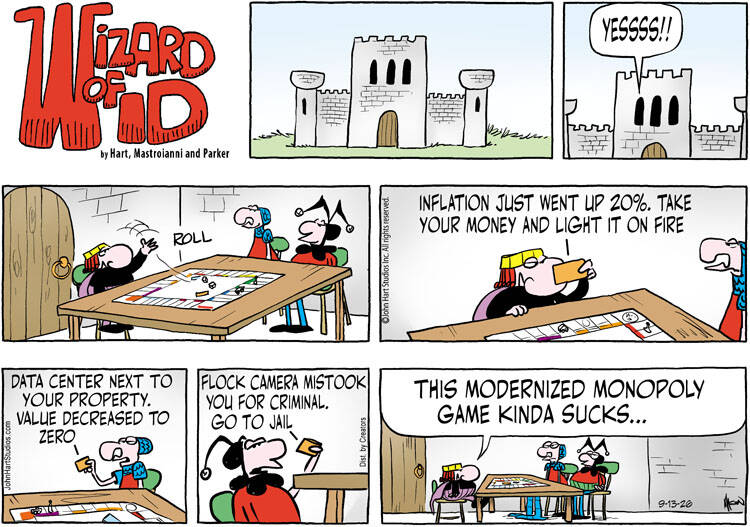
Monopoly, Black Mirror Edition

Wizard of Id — 13th September 2026

Wizard of Id — 13th September 2026

Not being a fan of monopoly when it comes to Good Boardgames™ (try Suburbia or Tigris & Euphrates if you want something actually good), but we really need an interactive media experience closer to Black Mirror or Years and Years. AI Safety is a big issue today, but no one wants to watch or play the media from the 80ies (WarGames), 90ies (The Net) or 2000s (I, Robot, A.I., Minority Report).

Consumer protection and environmental impact

In the late 1970s, concerned by resource use and scarcity, German industrial designer Dieter Rams developed his “ten principles for good design”. Among other things, he argued for design that is long-lasting and environmentally friendly. Half a century later, his concerns are more relevant than ever.

Repair is vitally important to making this happen, but current options are often limited or unaffordable. When a device breaks, consumers can struggle to find repair information, let alone spare parts. This means it is often easier, quicker and cheaper to buy a whole new device.

Building on the success of ecodesign laws and energy labels that drove efficiency improvements in products and homes across Europe, the 2024 European Sustainable Products Regulation sets out a framework for wider product sustainability, with repairability as one of its core principles. Similarly, the EU Batteries Regulation set requirements and conditions for how easy it is to replace batteries.

The EU’s repair policies are changing the way tech is designed

Personally, I believe the best course of action is to make product companies a stakeholder that aims to have longer lasting products, instead of regulation around electronics. The Australian Consumer Law gives assurances that the acquired goods are of acceptable quality, which includes their duration. If a car or a phone does not last for the expected lifetime of that device, the seller is liable. In Europe, we simply require products to have a longer by-default warranty (4 years for phones instead of 2+1) and manufacturers would now care about repairability and durability of their devices. And, since we're asking, this could include Software and Security updates as well.

Spaniards are having dinner earlier

Dinner in Europe can range from 6pm (in Nordic countries) to 10pm in Spain and Italy. Portugal sits in the middle at 8pm, although I have the feeling it is moving towards 9pm.

The Fork and CoverManager report that the average dine out in Spain is now before 9pm, and Cataluña's survey reports the same trend.

While the reasons for the change are not entirely clear, Marta Junqué Surià, the director of Time Use Initiative, a nonprofit based in Barcelona that advocates for policies around sleep and wellness, pointed to the pandemic, which ruptured old routines, and suggested more people were seeking the health benefits associated with earlier mealtimes.

The 10 P.M. Dinner Is a Spanish Tradition. Are People Giving It Up? by Jonathan Wolfe (NYT) (via Tyler Cohen)