Alcides Fonseca.AI & Programming Languages researcher
40.197958, -8.408312

Making intelligent software
more reliable.

I work on the intersection of AI, Software Engineering and Programming Languages. Currently, I am applying Formal Methods to Agents, towards AI Safety.

Program synthesisLiquid typesReliable AIGuardrailsEvals

Subscribe to the RSS Feed for new Web posts.

Are we finally solving micro transactions on the web?

I've previously written about how I believe the open web is dying. Maybe one solution to prevent it, and to save anonymity on the web is to finally fix the micro-payment that no-one ever solved.

Disclaimer: I started developing during the Web 1.0 age (a.k.a. dotCom era) and substantially improved my engineering skills during the Web 2.0 movement. I completely skipped all the Web 3.0 craze (unless you count the original Web 3.0 — the Semantic Web) not necessarily because of technical limitations, but because of the community around it. Now that everyone moved to AI, I think we can look at blockchain again, with more sober eyes.

Agents have the potential multiply the web traffic by a thousand fold or more. As an early example in software engineering (the early adopters of autonomous AIs), git traffic has increased in Github and at Anthropic and OpenAI so much they all needed new infrastructure to handle this increased load. The same is happening all across the industry.
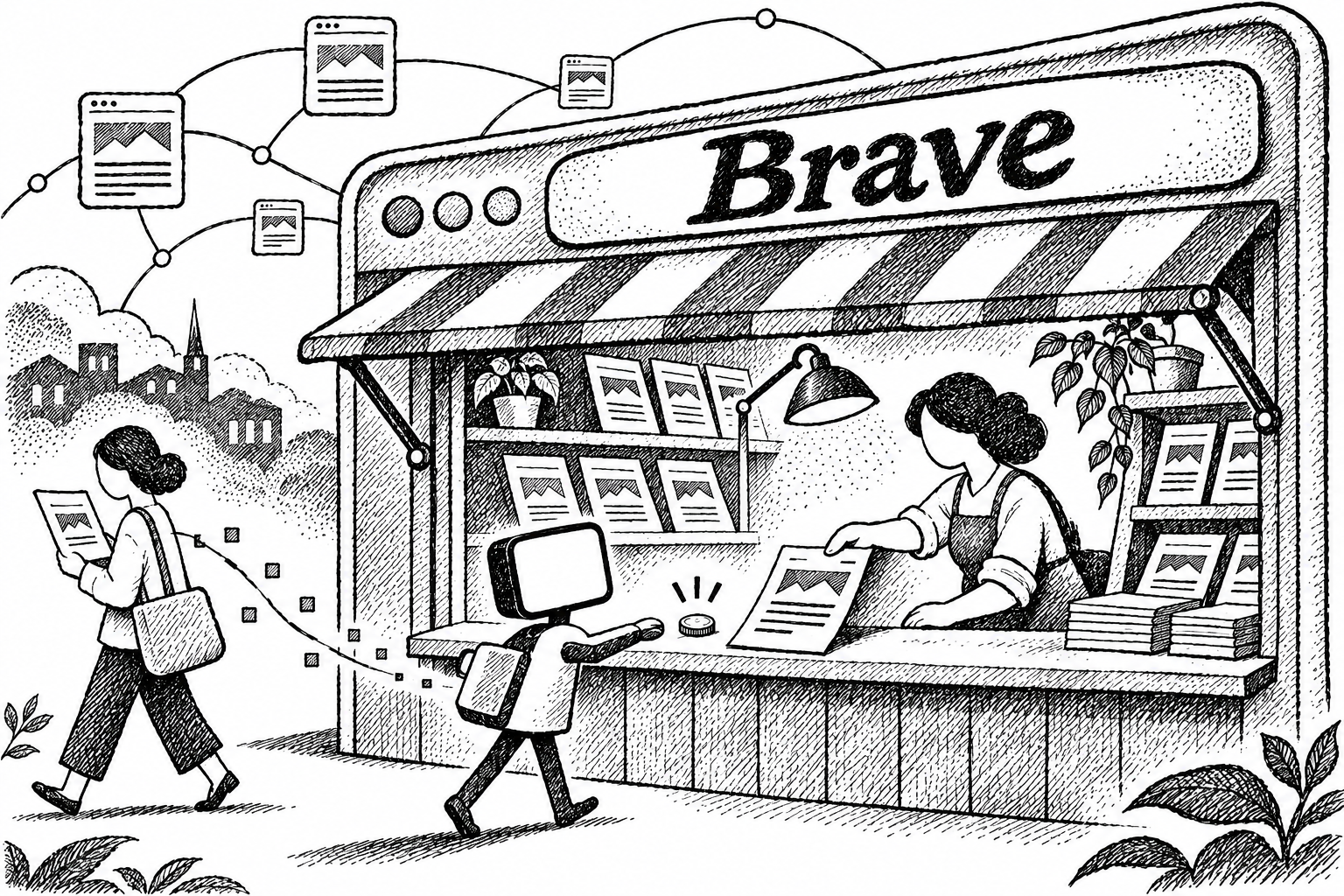
AI-generated illustration for a small robotic agent buying a webpage from Brave

As agents become the UI for the whole internet, many service providers lose their ad-based income and become unsustainable. I applaud Brave's initiative to change the economics and start charging for agent access (although I believe it will spill over to human access as well).

Pricing follows Brave’s published API rates: LLM Context, an API designed specifically for providing search context for agents, will cost $0.005 ($5 per 1,000). Additionally, web (search for humans), news, image, video, and local endpoints will also be available for $0.005 ($5 per 1,000). Gas fees for transacting on the Base blockchain will be covered for a limited time. Since each request carries its own payment, a Brave Search API account is no longer needed to use the service.

— The Brave Search API now accepts agentic payments via the x402 protocol

Anonymous (as anonymous as blockchain can be) payments may solve the problem of the anonymous internet. You no longer need to create user accounts and prove you are human. As long as you pay for the service it does not matter. Except for age verification, which is still a problem. But it solves the lack of monetization of past-user-facing services that are now MCP providers and APIs. And at the same time it might also help prevent DDoS attacks from LLM crawlers, such as the ones this website has been suffering from (Hello dear Singaporean bots!).

Brave will be using the x402 protocol, which I was unaware of, despite knowing the 402 error code. That protocol is not yet widespread, but if bigger players start adopting it, maybe with an Apple Pay-like authorization prompt guard railing agentic purchases, we might see it succeed soon.

Designing for Dual Screen and Foldable Devices With CSS - Stephanie Stimac's Blog

The horizontal-viewport-segments query targets the device when it is being held like a book and the two screens are side-by-side.

And vertical-viewport-segments targets the device when the two screens are stacked on top of each other and fold like a laptop. I've found this mode useful when using my Surface Duo with PowerPoint. I can access my speaker notes on the bottom screen and my presentation is on the top screen. Pretty snazzy.

— Designing for Dual Screen and Foldable Devices With CSS - Stephanie Stimac's Blog

With the advent of foldable devices (which I predict will last for only 5 years), it is important to know how to develop against them. It never crossed my mind that you might want a webpage that is aware of the fold, but if you want a web-only version of powerpoint (or gameboy emulator), it totally makes sense.

The Monopoly in Browsers

I remember the dark old times where IE6 was the default browser everywhere. Because of that dominance, developers focused solely on the IE substandard of JS/ActiveX/JavaApplet, leaving Linux and Mac users behind. Not long ago, you were required IE to submit your taxes. That has changed: Now you are required Chrome or Edge. As a Safari user, I find myself having to have an installed Chrome to access unsupported websites.

This week, MS announced they would be dropping their own rendered (EdgeHTML, a fork of Trident) on their current browser Edge and they will be using Chrome’s Blink (itself a fork of Webkit). So now the major browsers are:

  • Edge (Webkit/Blink)
  • Chrome (Webkit/Blink)
  • Firefox (Quantum Render, replacing Gecko)
  • Safari (Webkit)

Except for the tiny differences between vanilla Webkit and Blink, almost all the web uses the same renderer. This is the same monopoly Trident (IE5/6) had more than 10 years ago! And the sole fighter for a diverse web is the same browser and team that fought then: Mozilla Firefox! And this is not by chance: Mozilla’s Foundation is all about diversity and open standards. Just check their funded research projects to see that they put their money where their mouth is.

If it weren’t for Firefox, I believe Chrome would never had the success it had. Now Chrome’s the one that’s monopolising the web, and we need Firefox to be an alternative that will allow the NextBrowser™ to replace Chrome in 10 years.

I’ve been using Firefox as my main browser for a while now, and I can heartily recommend it. You should try it (and maybe talk to your relatives about it at Christmas). At this point, which browser you use no longer feels like it’s just about personal choice—it feels part of something bigger; it’s about the shape of the web we want.

— Jeremy Keith